What is Proxmox?
So I've been meaning to write this up for a while. I work in IT, I deal with virtualization and infrastructure daily, and I still think Proxmox deserves more attention than it gets in professional circles. Most of the content out there about it is aimed at homelab beginners which is fine, but I want to talk about it from the perspective of someone who actually knows what they're looking at.
This isn't a beginner's guide. I'm not going to explain what a virtual machine is. I just want to share why Proxmox has genuinely impressed me and where I think it fits in the broader landscape of virtualization tools.
How I ended up here
I'd been using other solutions at work for years. VMware has been the industry standard for so long that questioning it almost feels weird, but honestly the licensing costs have gotten increasingly hard to justify, especially for smaller environments. Hyper-V is fine but it always feels like a Microsoft-first solution that tolerates everything else. I wanted something that felt more at home in a mixed Linux environment without constantly fighting against the grain.
Proxmox had been on my radar for a while, I'd seen it come up in conversations, seen it used in a few smaller business setups, but I'd never sat down and properly used it myself. I decided to spin it up on a spare machine one weekend and just dig in. I was genuinely surprised by how polished it's become. This isn't the rough-around-the-edges open source project it might have been a few years ago. It feels mature and well thought out.
Visit Proxmox: Proxmox – Powerful open-source server solutions
What Proxmox actually is, quickly
For anyone reading this who somehow doesn't know, Proxmox VE is an open source enterprise virtualization platform built on Debian. It combines KVM for full virtual machines and LXC for containers, managed through a unified web interface backed by a solid REST API. It supports clustering, shared storage, live migration, high availability, the full stack of features you'd expect from an enterprise hypervisor. And it's free, with an optional subscription for enterprise repo access and support.
That's really the pitch in a nutshell. Everything you'd pay a significant amount of money for elsewhere, available without a licensing headache.
KVM and LXC together — this is where it gets interesting
If you're coming from a VMware or Hyper-V background you're used to thinking purely in terms of VMs. Full virtualization for everything, every workload gets its own OS, done. And that works, but it's not always the most efficient approach.
The ability to run LXC containers alongside KVM VMs in the same platform, managed from the same interface, is something I think gets undersold. For workloads that don't need full OS isolation, your web servers, reverse proxies, DNS, monitoring stacks, lightweight services, containers are just the smarter choice. They spin up in seconds, use a fraction of the RAM and disk that a full VM would, and are easy to snapshot and move around. I've got environments where I'm running dozens of containers handling various services and the resource overhead compared to running equivalent VMs is significant.
At the same time, when you need full VMs you've got them. Windows workloads, anything that requires its own kernel, anything where you genuinely need that hardware-level isolation, KVM handles it all cleanly. PCIe passthrough works well too which matters for certain workloads.
Being able to make that call on a per-workload basis without switching platforms or tools is genuinely useful. It sounds simple but it changes how you think about resource allocation.
The management interface - better than expected
I'll be honest, I was ready to mostly ignore the GUI and live in the CLI and API. That's where I'm comfortable and a lot of enterprise tools have web interfaces that are more trouble than they're worth.
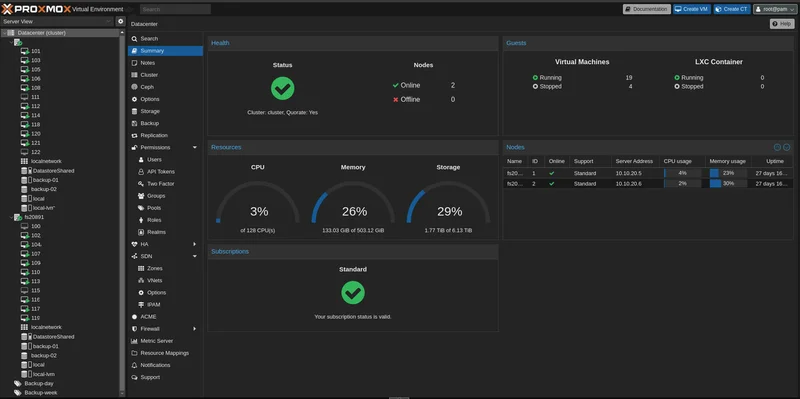
Proxmox's interface actually earns its place though. It's clean, responsive, and logically structured. The node and resource tree on the left gives you a clear picture of your entire environment at a glance. VM and container management, storage, networking, cluster status, it's all where you'd expect it to be. For quick tasks and monitoring it's genuinely faster than dropping to a terminal.
The console access built into the interface is solid too. Both noVNC and SPICE are available for VMs, and the shell access for containers works well. Not a replacement for proper SSH access but useful for quick checks or when you're on a machine that isn't set up with your usual SSH keys.
What I really appreciate though is the API. Everything the UI does is backed by a well documented REST API which means it plays nicely with automation and Infrastructure as Code workflows. Terraform has a Proxmox provider, Ansible works well with it, you can script pretty much anything. For anyone running a properly managed environment rather than just clicking through a GUI, this matters a lot.
Backups and snapshots - this is solid
Proxmox has built-in backup functionality through Proxmox Backup Server, which is a separate product but integrates tightly. You get deduplication, incremental backups, encryption, and a proper retention policy system. For a free solution the feature set is genuinely comparable to what you'd pay for elsewhere.
VM snapshots work as you'd expect, quick point-in-time states you can roll back to. Useful during maintenance windows or when testing changes on production-adjacent systems. Combined with the scheduled backup system you've got a pretty robust data protection setup without bolting on third party tools.
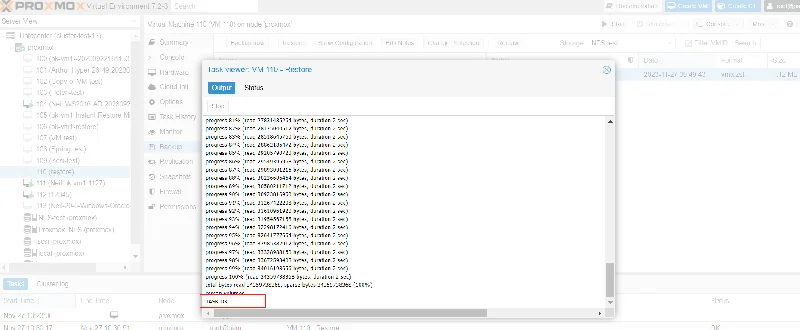
I've used the restore process under pressure a few times and it's been reliable. Fast enough, straightforward enough, no surprises. That last part matters more than people give it credit for, the last thing you want during an incident is a restore process that behaves unexpectedly.
Clustering and HA - worth knowing about
Proxmox supports multi-node clustering with live migration and high availability. The setup is reasonably straightforward compared to building equivalent functionality in some other platforms. Corosync handles the cluster communication, and you get a shared resource view across all nodes in the cluster from a single interface.
HA works by defining groups and priorities for VMs and containers so that if a node goes down the affected workloads get restarted on surviving nodes automatically. It's not magic, you still need shared storage and proper network configuration for it to work reliably, but when it's set up correctly it does what it's supposed to do.
For a small to medium business environment or a well-resourced homelab, this is genuinely enterprise-grade functionality without the enterprise price tag.
Where it fits and where it doesn't
I want to be realistic here. Proxmox isn't going to replace VMware in a massive enterprise environment with thousands of VMs, dedicated vSAN storage, and a team of engineers who've been working with vSphere for a decade. The ecosystem around VMware, for all its cost issues, is deep. The tooling, the integrations, the institutional knowledge, that stuff has real value.
But for small to medium businesses, branch environments, development infrastructure, or anyone who is tired of licensing costs eating into the budget, Proxmox is absolutely worth serious consideration. The feature-to-cost ratio is hard to argue with. And for homelab use? It's frankly the obvious choice at this point.
The support situation is worth mentioning too. The community is active and knowledgeable, the documentation has improved a lot, and if you need proper support you can get it through a subscription. It's not the same as having a VMware enterprise agreement with a dedicated TAM but for most use cases it's more than adequate.
Final thoughts
I've been running Proxmox across a few different environments now and my overall impression is that it's earned its place as a legitimate production-grade virtualization platform, not just a free alternative that you tolerate. The KVM and LXC combination gives you real flexibility, the management tooling is solid, the API makes automation straightforward, and the backup and HA features are genuinely good.
If you haven't looked at it seriously in a while it's worth another look. It's come a long way and the gap between it and the paid alternatives has narrowed considerably. At some point the question stops being "is Proxmox good enough" and starts being "what are we actually paying for with the expensive stuff."
For me at least, that question is getting harder to answer.